

In Brief
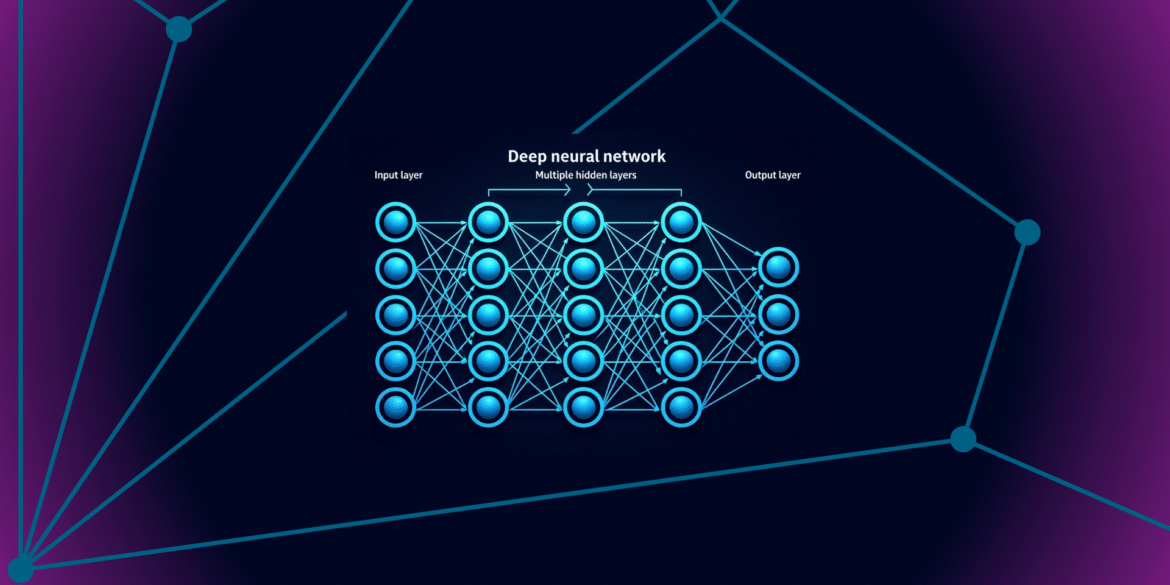
A neural network is a computational model inspired by the human brain’s structure and function. It consists of interconnected artificial neurons that process and transmit information, enabling computers to recognise patterns, make decisions, and solve complex problems in artificial intelligence and machine learning.
The Details
Neural networks, also called artificial neural networks (ANNs), are a core technology in machine learning and deep learning. They mimic how biological neurons work together to identify patterns, evaluate options, and reach conclusions. Neural networks are especially powerful for learning from data without explicit programming, supporting functions like image recognition, natural language processing, and autonomous systems.
Core Components and Structure
-
Neurons (Nodes): Basic units that receive inputs, perform calculations, and generate outputs for the next layer.
-
Layers:
-
Input layer receives raw data such as images or text.
-
Hidden layers transform the data via interconnected neurons.
-
Output layer produces the final prediction or decision.
-
-
Weights and Biases: Parameters tuned during training that control the influence of inputs and activation thresholds.
-
Activation Functions: Apply non-linear transformations (e.g., ReLU, sigmoid) to capture complex patterns beyond linear relationships.
How Neural Networks Work
-
Input processing: Raw data enters the input layer.
-
Weighted calculations: Inputs are multiplied by weights and summed up with biases.
-
Activation: The activation function decides whether neurons activate, introducing non-linearity.
-
Output generation: The final layer produces the network’s prediction or classification.
Training Process
-
Initialisation: Weights and biases start with random values.
-
Forward propagation: Data passes through the network generating outputs.
-
Error calculation: The difference between predicted and actual outcomes is measured.
-
Backpropagation: Errors are sent backward to update weights and biases using gradient descent.
-
Iteration: This cycle repeats until the network reaches the desired accuracy.
Applications
Neural networks have diverse applications:
-
Image and speech recognition
-
Natural language processing
-
Financial forecasting
-
Medical diagnosis
-
Autonomous vehicles
Example
A neural network trained to recognise handwritten digits processes input images through its layers, identifying pattern features like curves and lines. When given an image of “7,” it outputs the classification “7” based on learned features.
Ongoing Advancement
Research continues to enhance neural networks’ ability to work with larger datasets, model complex systems, and adapt across various fields. Their evolving capabilities are central to driving innovations in AI and solving challenging real-world problems.