

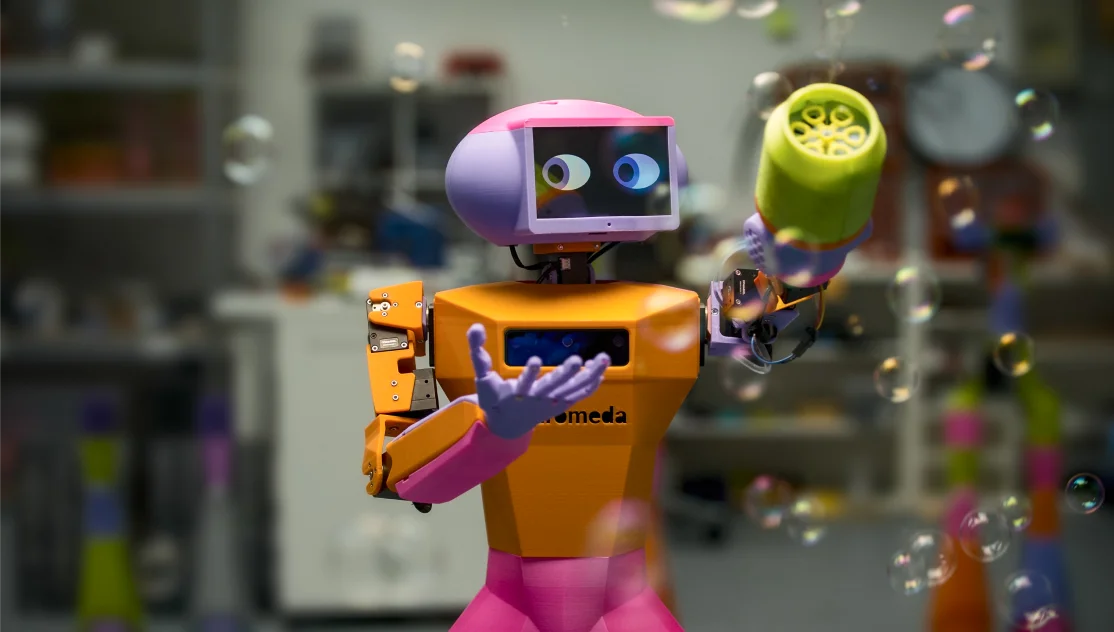
Caring for an ageing population has become one of Australia’s defining challenges — and opportunities — of the 2020s. With workforce shortages deepening across the aged-care sector, the integration of robotics is shifting from novelty to necessity. Enter Abi, Andromeda Robotics’ personalised social companion, designed to bring conversation, comfort, and cognitive support to older Australians.
Headquartered in Prahran, Melbourne, Andromeda Robotics specialises in developing socially intelligent service robots that blend human-like emotional understanding with AI-powered adaptability. Its flagship product, Abi, emerged from a three-year research and pilot program spanning hospitals, aged-care facilities, and individual homes in New South Wales and Victoria.
Abi isn’t designed to replace carers. Instead, its purpose is to assist them — to fill emotional and social gaps when human presence isn’t always possible. The robot can engage residents in natural conversation, remind users to take medication, initiate games or mental exercises, and detect signs of loneliness or distress through speech and facial recognition.
According to the Australian Institute of Health and Welfare’s 2024 report, over 1 in 6 Australians are currently over 65, with that figure expected to climb sharply by 2035. In parallel, the Department of Health estimates the sector faces a shortfall of 100,000 aged-care workers by 2027. Artificially intelligent companions like Abi present a partial solution to this structural deficit.Abi’s design focuses on approachability and comfort. Standing about one metre tall, the unit’s rounded aesthetic and soft facial cues were deliberately engineered to feel more therapeutic than technical. Using Andromeda’s EmotionSense™ AI modelling, Abi learns an individual’s emotional patterns, adapting its responses over time to mirror human empathy and recall user preferences — from favourite songs to daily routines.
At its core, Abi integrates three layers of intelligent technology:
- Conversational AI powered by natural language models trained for everyday English and multilingual contexts common in Australian households.
- Computer vision and sensor fusion, allowing Abi to recognise gestures, track movement, and ensure safety within care environments.
- Adaptive personality learning, enabling the robot to build and update an emotional profile for each user to personalise interactions.
This architecture connects to Andromeda’s secure cloud platform where anonymised data helps refine Abi’s responses while maintaining user privacy in alignment with Australian privacy laws (Privacy Act 1988).
Abi has already been trialled across more than a dozen aged-care facilities, including partnerships with providers on the East and West coasts. Feedback from early trials highlights measurable gains in resident engagement and mood stability, particularly among those with mild cognitive decline or limited family contact.
Andromeda Robotics is positioning Abi as a subscription-based hardware-as-a-service (HaaS) product — a model that aligns with both healthcare cost management and continuous AI improvement. Facilities can lease Abi units with built-in software updates and remote monitoring. Globally, aged-care robotics is projected to become a $25 billion industry by 2030, according to Deloitte’s 2025 forecast. For Australia, the technology holds dual potential: to support overextended carers and to strengthen the country’s leadership in ethical AI and care innovation.
Andromeda’s engineers are already exploring future integrations with telehealth systems, wearable health data, and hospital triage software. The long-term vision: creating a connected ecosystem where robotics, clinicians, and families collaborate through shared data and AI-driven insight.
CEO Dr. Emily Tran frames Abi’s mission not in terms of automation, but augmentation. “Abi isn’t here to replace care,” she says. “She’s here to ensure everyone, regardless of staffing pressures or geography, can have someone — or something — that listens, learns, and supports.”For an industry under pressure, Abi represents something rare: technology that not only scales but also humanises care delivery. The fusion of empathy with AI precision could soon make Abi as common in aged-care residences as blood-pressure monitors or mobility aids.
References & Further Reading
- Andromeda Robotics: Company Homepage
- Abi Product Information: Abi’s Product Page
- “Robot Abi gets an upgrade and $23m to grow” – Australian Ageing Agenda, 14 Sep 2025
- Andromeda raises $23m for global Abi robot launch (LinkedIn post)
- Andromeda raises AUD $23m to launch robots for aged care (IT Brief)
- Backed by women, Grace Brown secures $23m for robotics (Women’s Agenda)
- “Friendly and futuristic: how robots are changing life in aged care” – Talking Aged Care, 5 May 2025
